The PAMEC Energy Association held PAMEC 2026 in Rio de Janeiro, Brazil. The event began with workshops on April 10 and 11, followed by the main conference from April 12 to 15.
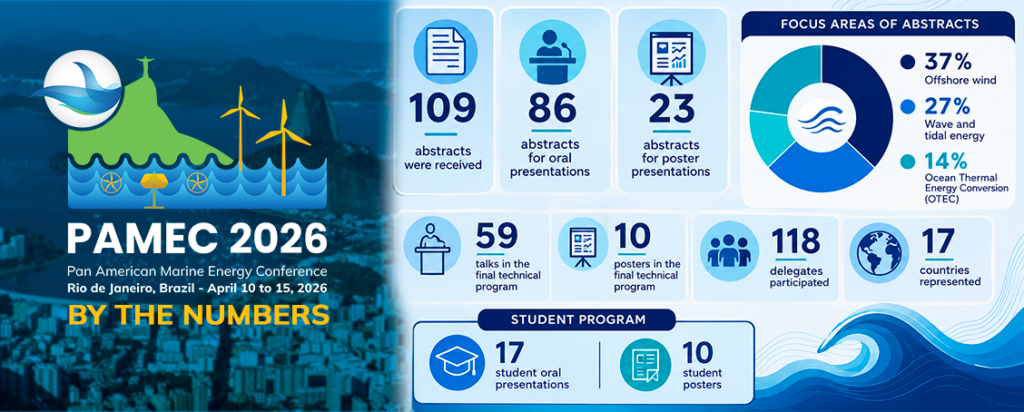
The conference was described as highly successful, with record numbers of registered delegates, oral presentations, posters, and workshops. The scientific and engineering quality of the contributions was considered among the strongest seen at PAMEC to date, and the level of engagement from participants was particularly high.
The event also stood out for its strong regional participation, especially from Latin America, and for its combination of academic, student,
government, and industry perspectives.
The PAMEC Energy Association held PAMEC 2026 in Rio de Janeiro, Brazil. The event began with workshops on April 10 and 11, followed by the main conference from April 12 to 15.
Student and Industry Participation
Student participation from Latin America was particularly high. Students presented work from Brazil, Colombia, Costa Rica, Mexico, Uruguay, and Chile. The level of enthusiasm among students and researchers was evident throughout the conference, both in the technical sessions and in informal interactions. Industry participation was also significant. Representatives attended from companies and organizations connected to tidal energy, wave energy, OTEC, offshore energy, oil and gas, and consulting engineering. This broad participation reinforced the role of PAMEC as a meeting point between research, technology development, policy, and industry.Venue and Local Organization
The conference benefited from strong local organization and support. The facilities at the university and hotel were positively evaluated, with good audio-visual support and hospitality. Participants also had the opportunity to experience Rio de Janeiro, including its cultural and natural attractions.
 Pre-Conference Workshops Four workshops were held at the Windsor Florida Hotel in Rio de Janeiro, which served as the official conference hotel. All four workshops reached their registration limit of 50 participants. The workshops were described as highly engaging, interactive, and valuable for participants.Workshop 1: Floating Offshore Wind and Marine Energy (sponsored by American Bureau of Shipping (ABS)). The workshop was aligned with the expansion of offshore wind activity in Brazil and other parts of Latin America. It addressed offshore wind, marine energy, standards, lifecycle considerations,and converter technologies.Workshop 2: Environmental Effects of Remote Community Marine Energy (sponsored by Ocean Energy Systems (OES) was organized by Pacific Northwest National Laboratory (PNNL), Ocean Energy Systems-Environmental (OES-E), and Aquatera Limited.). It included presentations and small-group discussions. Participants explored potential environmental effects and regulatory solutions for off-grid wave energy and ocean thermal energy conversion applications. Attendees included engineers, industry representatives, students, and researchers.Workshop 3: the International Electrotechnical Commission Renewable Energy System certification group for marine energy, IECRE, held a three-hour workshop titled: International Standards, Testing & Certification (sponsored by Lloyd’s Register and Streamwise Development.). It focused on standards, testing processes, and certification frameworks for marine energy technologies. The session was highly interactive and well received by delegates.Workshop 4: From Research to Real-World Impact in Marine Energy (helded by European Marine Energy Centre (EMEC) and the Fundy Ocean Research Centre for Energy (FORCE). The workshop emphasized the central role of test centers in marine energy development. It addressed how research infrastructure, demonstration facilities, and testing centers can help move technologies from laboratories and controlled environments toward real-world deployment.Main PAMEC 2026 Conference Program     POES: A New Era for Pan-American Ocean Energy Students POES: A New Era for Pan-American Ocean Energy StudentsThe Pan-American Ocean Energy Students network, POES, is entering a new phase of growth and restructuring. The objective is to empower and strengthen student engagement across the Americas in marine renewable energy. POES was originally founded in 2020 through collaboration between CEMIE-Ocean and the PAMEC Energy Association. It grew into a student-led network with ambassadors in more than nine countries. During its first phase, POES supported interdisciplinary collaboration among universities, research centers, students, and early-career researchers. The network contributed to competitions, conferences, and initiatives such as the Marine Energy Collegiate Competition (MECC). It also developed partnerships with international student organizations such as INORE. Beyond technical work, POES helped create a sense of community and long-lasting professional relationships across the region, from Canada to Argentina. LEARN MORE  Research Publications and Scientific Outputs Research Publications and Scientific OutputsField Experiences and Technology Demonstration This section brings together three relevant field-based initiatives: the Mewlen floating wind prototype in Chile and the OSIP monitoring platform led by FORCE in Canada. Although they address different technologies, both cases highlight the importance of testing offshore renewable energy systems under real environmental conditions.  Mewlen Floating Wind Project in Chile: Mewlen Floating Wind Project in Chile:The Mewlen project, led by Universidad Austral de Chile, has reported positive results after its first stages of operation in real offshore conditions in the inland sea of Chiloé, Chile. Mewlen is a floating marine wind energy prototype installed in the Chacao Channel, in the Manaos sector of Ancud. The platform is approximately 13 meters high and is equipped with a 10 kW wind turbine. The project seeks to validate offshore wind technology adapted to the environmental and operational conditions of southern Chile, with potential applications in the aquaculture industry and isolated communities.  FORCE and the OSIP Platform in CanadaThe Fundy Ocean Research Centre for Energy, FORCE, is preparing for the launch of the Ocean Sensor Innovation Platforms project, OSIP, in Nova Scotia, Canada.The OSIP project is a collaborative initiative involving Acadia University, Ocean Tracking Network, Pacific Northwest National Laboratory, and other partners. It represents an important step toward improving monitoring for tidal energy in the Bay of Fundy, one of the world’s most energetic tidal environments. FORCE and the OSIP Platform in CanadaThe Fundy Ocean Research Centre for Energy, FORCE, is preparing for the launch of the Ocean Sensor Innovation Platforms project, OSIP, in Nova Scotia, Canada.The OSIP project is a collaborative initiative involving Acadia University, Ocean Tracking Network, Pacific Northwest National Laboratory, and other partners. It represents an important step toward improving monitoring for tidal energy in the Bay of Fundy, one of the world’s most energetic tidal environments. Panthalassa Wave Energy Concept Panthalassa Wave Energy ConceptPanthalassa, a renewable energy company based in Portland, Oregon, has developed a new wave energy converter concept and recently secured a significant USD 140 million investment to support its transition from open-water testing toward commercial development. The company conducted initial open-water testing in 2021 and 2024 and plans to advance toward commercial development in 2027. Its device, referred to as a “node”, is a solid-state structure designed to use wave motion to continuously force water into a pressurized reservoir located inside a spherical upper body of approximately 50 meters in diameter. A neck extending 60–70 meters below the sea surface allows the motion of the structure to pump water into the reservoir. Presentations, Knowledge Sharing and Sector Engagement This section brings together recent dissemination and sector engagement activities, including academic presentations, technical knowledge sharing, and participation in broader energy transition events.Marine Energy Collegiate Competition 2026: The 2026 U.S. Marine Energy Collegiate Competition (MECC) recently concluded with final presentations in Portland, Oregon. A total of 27 graduate and undergraduate student teams participated in the competition. Funded by the U.S. Department of Energy, MECC is a year-long competition designed to provide students with practical experience in marine energy innovation. The competition supports student learning in market analysis, technical design, prototype testing, and community engagement. International students are welcome to participate, although they are not eligible for U.S. funding or cash prizes. Thirty teams have already been selected for the 2027 edition, indicating continued student interest and growth in marine energy education and innovation. Chile Brilliant Blue Challenge: A new edition of the Brilliant Blue Challenge has recently been launched in Chile through a collaboration between Copas Coastal, PVM Consulting, and the international Brilliant Blue Challenge initiative. The competition encourages students between 12 and 18 years old to develop science-based solutions to major ocean challenges. The initiative is aligned with the United Nations Sustainable Development Goal 14 (Life Below Water) and the objectives of the High Seas Treaty (BBNJ). As part of this initiative, Dr. Fabian Pierart, Director of the GROW-E research group at Universidad del Bío-Bío and member of the PAMEC Energy Association Board of Directors, will participate as a mentor supporting student teams during the competition. The program aims to strengthen ocean literacy, innovation, and youth engagement in marine science and engineering across Chile.Other Relevant Events, Calls, and Opportunities Fellowships, Funding, and Competitions The following opportunities were identified as relevant to the marine energy and offshore renewable energy community: • VentureWell has opened applications for Stage 1 of its Ocean Enterprise Accelerator, which supports U.S. innovators developing ocean data technologies and services. Application deadline: July 7, 2026. • UK Research and Innovation has opened applications for the Clean Maritime Demonstration Competition 7: Deployment Trials. The program funds real-world demonstrations of clean maritime technologies in operational settings. Application deadline: July 15, 2026. Conferences, Abstract Calls, and Events Relevant upcoming conferences and calls include: • Energy Summit Global. Rio de Janeiro, Brazil, June 23–25, 2026. This event focuses on the global energy transition and includes discussions relevant to offshore energy and the ocean economy. • OCEANS 2026 Monterey. Monterey, California, USA, September 21–24, 2026. The Call for Workshops and the Call for Town Halls and Panel Sessions remains open until July 20, 2026. • 13th PRIMaRE Conference. Loughborough, England, June 23–24, 2026. • OSES 2026 – 10th Offshore Energy and Storage Symposium. Delft, Netherlands, July 8–10, 2026. • UMERC Annual Conference / Marine Energy Technology Symposium (METS). Hoboken, New Jersey, USA, August 4–6, 2026. Webinars and Technical Events Relevant webinars and technical events include: • 2nd Anemoi Stakeholder Event. Online, June 20, 2026, 2:00 PM CEST. Hosted by the Interreg North Sea Anemoi project. The event includes presentations on project progress, chemical emissions from offshore wind to the marine environment, offshore regulations, and potential effects from offshore wind leachates. • Microgrid Power Hardware-in-the-Loop Modeling. Online, August 10, 2026, 12:00 PM MDT. Part of the Marine Energy Microgrid and Power Electronics Webinar Series hosted by the National Laboratory of the Rockies. Job and Internship Opportunities The following job and internship opportunities were identified: • The University of Victoria and Institute for Integrated Energy System are offering opportunities for one Doctoral student and one Master of Science graduate student to help direct innovative research at the intersection of ocean renewable resources, technology development, and integrated value to communities and utilities. • The Centre for Ocean Energy Research (COER) at Maynooth University is recruiting PhD researchers to work on cutting-edge ocean energy projects in collaboration with leading international academic and industrial partners. Areas of interest include control co-design, marine renewable energy systems, hydrodynamic modelling, nonlinear optimization, wave energy conversion, and tidal energy technologies. Policy and Sector News Costa Rica presented the 2026–2030 Action Plan for the operationalization of its National Decarbonization Plan. The process included public institutions, private sector stakeholders, civil society, and academia. The plan constitutes an update to the country’s national climate public policy framework and was coordinated by the Ministry of Environment and Energy of Costa Rica, with support from the NDC Partnership and UNDP Costa Rica. In this broader national context, RED MARE CR represents an important scientific and technical platform for advancing marine renewable energy in Costa Rica. RED MARE CR is a multidisciplinary network of professionals from Costa Rica’s five public universities engaged in research and development activities in marine renewable energy. The network promotes scientific research, capacity building, knowledge transfer, and governance related to marine energy resources. RED MARE CR contributes to the Sustainable Development Goals, national decarbonization targets, blue economy initiatives, and climate resilience strategies. Its strategic plan includes six objectives related to scientific research, technological innovation, environmental sustainability, and socioeconomic development. |